Tāne’s Tree Trust Documents

  • About
  • TTT home

Establishing Native Forests

Download PDF
Tāne’s Tree Trust
Establishing Native Forests

Establishing Native Forests

Tāne’s Tree Trust Factsheet Series

Environmental values of native forests

Factsheet 10

Refer to the other factsheets in this series for more about successfully establishing native forests.

Over 9 ha of riparian zones have been fenced along the Awahou Stream, which flows into Lake Rotorua. Exotic brush weeds have been cleared and tens of thousands of native shrubs and trees have been planted to improve water quality. This project was led by Jaap and Sue van Dorsser and is just one example of community involvement in best-practice planting and management of native forest along waterways.

Introduction

Tens of millions of native trees and shrubs are being planted annually throughout New Zealand by various agencies, landowners, iwi, and community groups for environmental reasons. These include enhancement of native plant and animal biodiversity, establishment of native forest cover on erosion-prone sites and improvement of water quality by revegetation of riparian areas.

Prior to human arrival, New Zealand was almost entirely forested below the treeline. The current forested area represents over a 70% reduction from the pre-human state. This large-scale deforestation has been disastrous for our soils, water quality and biodiversity.

However, there is now increased awareness of the importance - and vulnerability - of New Zealand’s environment. The New Zealand Tax Working Group Report (2019) stated that “The well-being of New Zealanders is critically dependent on the state of our natural environment …” and acknowledges natural capital (resources) as “a profound and non-substitutable basis for the economy”.

We now have the opportunity to strategically restore native forest. Large-scale planting of natives is being undertaken in both urban and rural areas in many regions, supported by local authorities and community groups. Most visible are the large areas along roads and motorways. Other planting programmes are evident beside rivers and streams where natives are planted in fenced-off riparian areas.

In this factsheet, we focus on the direct and indirect environmental benefits of establishing and managing native forests. To meet various environmental objectives, most revegetation programmes use a wide range of native species to fulfil one or more of the following aims:

  • Protecting and enhancing wildlife values and indigenous biodiversity;
  • Controlling soil erosion of steep hill country, particularly pastoral lands;
  • Establishing natives along riparian areas to improve water quality;
  • Extending forest remnants on farms and establishing wildlife corridors across productive landscapes;
  • Providing shelter, shade or screens on farms, horticultural blocks and in urban areas;
  • Contributing to local aesthetic or wider landscape values; and
  • Carbon sequestration (which is covered in Factsheet 12).

Protecting and enhancing indigenous biodiversity

Native forests have a critical role in habitat provision and biodiversity conservation in New Zealand. Most New Zealanders value - and increasingly identify with - our indigenous flora and fauna, as opposed to exotic species. Yet New Zealand’s extinction rates are among the highest in the world. More than half of amphibians and roughly a third of mammals, birds, fish and reptiles are threatened, and many native plants are at risk, including the iconic kauri.

Native forests are critical for the survival of most of New Zealand’s terrestrial native fauna, particularly fruit and nectar feeders. Most of New Zealand’s native frugivorous and honey-eating bird and lizard species are co-adapted to native fruit- and nectar-bearing trees and shrubs. Recreational opportunities and connections with nature are also affected by loss of biodiversity, particularly the extinction of endemic species which are unique to New Zealand, i.e., found nowhere else. Kaitiakitanga (guardianship of natural resources) is an important cultural value linked with the conservation of native species.

Native forests support a greater diversity of indigenous species than exotic forests. Although native insectivorous birds and raptors are frequently found in radiata pine plantations, fruit and nectar feeders depend largely on native forests for their habitat. Both regenerating and planted native forests can have an important role in biodiversity conservation.

The main threats to native forests and indigenous biodiversity include habitat loss, fragmentation and resulting degradation, invasive plant species, introduced animals (browsers and predators) and incursions of new pathogens. Most of the loss and fragmentation of native forest occurs due to conflicts with other land uses.

Natural biodiversity is essential to our culture, identity and well-being. We call ourselves Kiwis and proudly display the native silver fern as a national symbol, indicating the importance of native species, especially endemic ones, to our national identity.

Diverse native forests free of pest animals provide a wide range of environmental, cultural and social benefits.

Indigenous biodiversity in our productive landscapes

Millions of native plants are being raised annually in community and iwi-based nurseries as well as in small to large-scale commercial native plant nurseries, for restoration projects to restore and enhance indigenous biodiversity. This includes large numbers of early successional, native broadleaved shrub species along with smaller numbers the major timber species.
  • New Zealand’s rural landscapes are dominated by agriculture, horticulture, and exotic plantation forestry, which collectively cover up to three-quarters of our land mass. Much of this human-created land use has been to the detriment of our indigenous biodiversity.
  • Concern is increasing about the ongoing decline in New Zealand’s indigenous biodiversity and for the ecological sustainability of land uses that support our primary industries (Parliamentary Commissioner for the Environment 2002). While the Commissioner strongly supports ongoing preservation initiatives to restore our threatened ecosystems, there has not been adequate exploration of the potential beneficial roles that native plants can play in our rural working lands.
  • As part of a broad range of management opportunities for including native plants within our working lands, there is plenty of scope for the planting and management of native trees.
  • In addition to the potential productive value of native tree plantations, the establishment of native forest in our rural landscapes is likely to improve productivity of the existing primary sector.
  • Significant areas of New Zealand’s rural and urban landscapes are being revegetated with native species.
Steep hill country pastoral land can be highly vulnerable to erosion once it is cleared of the original native forest cover. Allowing natural reversion along with planting and pest animal control are increasingly important in recloaking such landscapes in permanent native forest.

Steep hill country pastoral land can be highly vulnerable to erosion once it is cleared of the original native forest cover. Allowing natural reversion along with planting and pest animal control are increasingly important in recloaking such landscapes in permanent native forest.

Erosion control and catchment protection

Forests are vital for stabilising soils, reducing sedimentation, moderating water flows, and protecting downstream ecosystems and infrastructure from floods and sedimentation. These are increasingly important in an era of climate change where the expected increase in the frequency and intensity of floods will impact more severely in deforested catchments.

New Zealand has many regions vulnerable to erosion. Much topsoil has been lost and continues to be lost from unstable hill country after clearance of native forest and conversion to pasture. This loss of topsoil negatively impacts agricultural productivity and causes sedimentation of streams, rivers and harbours, degrading water quality and causing loss of biodiversity in freshwater, estuarine and marine ecosystems. Denuded hillsides shed more water than forested ones during intense rainfall events, leading to greater flood events and damage downstream.

There is a wealth of data showing that the area of soil eroded by storms is consistently less (in the range of 50% to 90%) where native forest is retained, or marginal land is allowed to revert. A million hectares of pastoral land are estimated to be at serious risk of erosion, a risk which could be reduced by establishing forests, especially permanent native forest on the steepest, most erosion-prone landscapes. Forests managed under continuous cover regimes involving small coup or individual tree felling could potentially provide small volumes of timber while retaining high forest values, including ongoing erosion control.

Government programmes recognise that avoiding erosion has significant long-term benefits beyond merely protecting the productive capacity of New Zealand’s pastoral and forest lands. There have been targeted grants that indicate the value of this environmental service provided by forests, i.e., the stabilisation of soils and prevention of erosion and sedimentation, as well as protection of downstream infrastructure and ecosystems.

With the increasing frequency of major storm events there is growing concern that clear-fell plantation forestry on steep erosion-prone hill country, often in remote areas, will be not be sustainable environmentally and economically. Clear-felling and downstream flooding with mobilisation of sediment and logging slash has devastated catchments in the East Coast and the Nelson regions. This is prompting calls for establishment of permanent native forest on such landscapes to provide the protection required in the face of more severe and frequent storms in future.

Fencing to exclude stock and planting riparian zones on pastoral farms with native shrubs and trees help to reduce stream bank erosion and sedimentation downstream.

Fencing to exclude stock and planting riparian zones on pastoral farms with native shrubs and trees help to reduce stream bank erosion and sedimentation downstream.

Riparian areas and improving water quality

Riparian areas are the zones of land along waterways that have an important influence on water quality depending on how they are managed. Most runoff must pass over or through the soil and vegetation of this zone before it reaches the adjacent water body. Riparian areas have a crucial influence in filtering out nutrients and moderating water flows and water temperature. They are buffers which moderate the adverse effects of adjacent land uses on stream, lake or estuarine systems.

Depending on the width of the zone, riparian vegetation works like a sponge by holding back the water and helping to protect the land from flood damage. Vegetation provides shade, moderating water temperature. Riparian zones also provide important habitat for wildlife both in the water and on the land (e.g., fish, birds and insects). They can be corridors that enable the passage of native fauna and flora across working lands dominated by farming, horticulture and exotic forestry land use, as well as in urban areas dominated by buildings, concrete and tarmac.

Riparian buffers help limit the negative impact of forestry operations and intensive agriculture. In regions where dairy farming has expanded, nitrate concentrations in waterways have increased and water quality has declined. Riparian planting can help reduce nitrate leaching as well as phosphate and sediment loss when established along waterways in pastoral landscapes.

Forests have extremely low nutrient leaching compared with pastoral agriculture. Catchments dominated by native vegetation or exotic forest have better water quality than those dominated by pasture or urban areas. Unharvested forests or forests managed under continuous cover regimes are also better than clear-fell regimes when it comes to maintaining water quality.

Resources providing information on riparian planting using appropriate native plant species are available on local council websites and through Tāne’s Tree Trust.

An urban waterway in south Auckland where a local high school has been clearing weeds and planting natives to provide wildlife habitat and improve water quality as part of environmental geography studies.

Extending remnants and establishing corridors

Much privately-owned native forest is contained in small, isolated fragments, many of which are unfenced and grazed. However, surveys of rural landowners show that protecting biodiversity is one of the most popular reasons for planting trees.

Protecting and enhancing existing forest remnants and pockets of regenerating shrubland within farmed landscapes is one of the easiest ways to make significant environmental gains. Fencing these native remnants and regenerating forests to exclude stock, along with pest control (deer, goats, pigs and possums) will likely see a diverse understorey of natives establish within a few years and the development of a diverse resilient taller forest within 2-3 decades. Supplementary planting of key native canopy tree species, particularly those that are locally scarce, along with control of any aggressive exotic species (e.g., wilding conifers, wild ginger) will eventually lead to a resilient and diverse high native forest.

Management of existing remnants of native forest, including fencing and supplementary planting, is required to reverse the decline of indigenous biodiversity in productive pastoral landscapes. Networks of riparian zones and shelterbelts of planted native trees can act as corridors by connecting remnant vegetation in gullies.

Regenerating forest can have an important role in the conservation of biodiversity. Recent research in Northland indicates that regenerating forest on private land can complement protected public conservation land and substantially improve connectivity of native forest habitat across pastoral landscapes. Species richness in regenerating native forest tends to increase with time, especially if grazing is excluded, pests are managed, and the stands are allowed to become more structurally complex.

Setting up networks of riparian zones and shelterbelts throughout a pastoral landscape can help to provide corridors of biodiversity connecting existing remnants of native vegetation to allow the passage of native fauna and flora.

Screens, buffers and shelterbelts

Shelterbelts can serve as a physical barrier to reduce wind speed and improve the local microclimate. However, shelterbelts can also provide important habitats for native wildlife.

There are many benefits to planting shelterbelts with native species, especially if a range of species are planted. They include:

  • Providing shelter for grazing stock, arable farming and horticulture from ground level to high level depending on the species planted;
  • Forming attractive low-maintenance buffers and screens, especially where multiple species and multiple rows are planted;
  • Stock can graze foliage to keep plants from overtopping fencelines;
  • Providing habitat for native wildlife acting as corridors or stepping stones to allow passage between existing native forest areas.

Depending on the design and width of the shelterbelt, planted native shelterbelts are also largely maintenance free once established. While there are a number of excellent native shrub species that can be hedged by regular trimming for urban environments (e.g., broadleaf, korokio, Pittosporum species), natives planted in rural areas as shelter for stock do not necessarily need trimming.

Native shelterbelts help to recreate natural habitats in productive landscapes by increasing indigenous biodiversity, providing shelter and food for a range of insects and birds. Networks of shelter and buffers also allow passage of native fauna within both urban and rural environments as corridors between native forest, shrubland and wetland areas.

In some instances, shelterbelts can also function as green firebreaks for fire risk reduction if low-flammability species are planted in a multi-tiered, closed canopy, perpendicular to predominant wind direction.

Wider multi-row shelterbelts are more effective than single-row belts. In multi-row belts, each plant can support and protect its neighbour. Planting more hardy, wind-tolerant species such as flax and mapou along edges assists in early establishment of less tolerant natives planted within shelter.

Many natives can be used in single and multi-row shelter on farms or as screens and buffers to provide shelter that can form networks of corridors connecting native forest and wetland ecosystems for passage of native flora and fauna. There is scope to inter-plant native trees that could be extracted as specialty timber in the long term.

Many natives can be used in single and multi-row shelter on farms or as screens and buffers to provide shelter that can form networks of corridors connecting native forest and wetland ecosystems for passage of native flora and fauna. There is scope to inter-plant native trees that could be extracted as specialty timber in the long term.

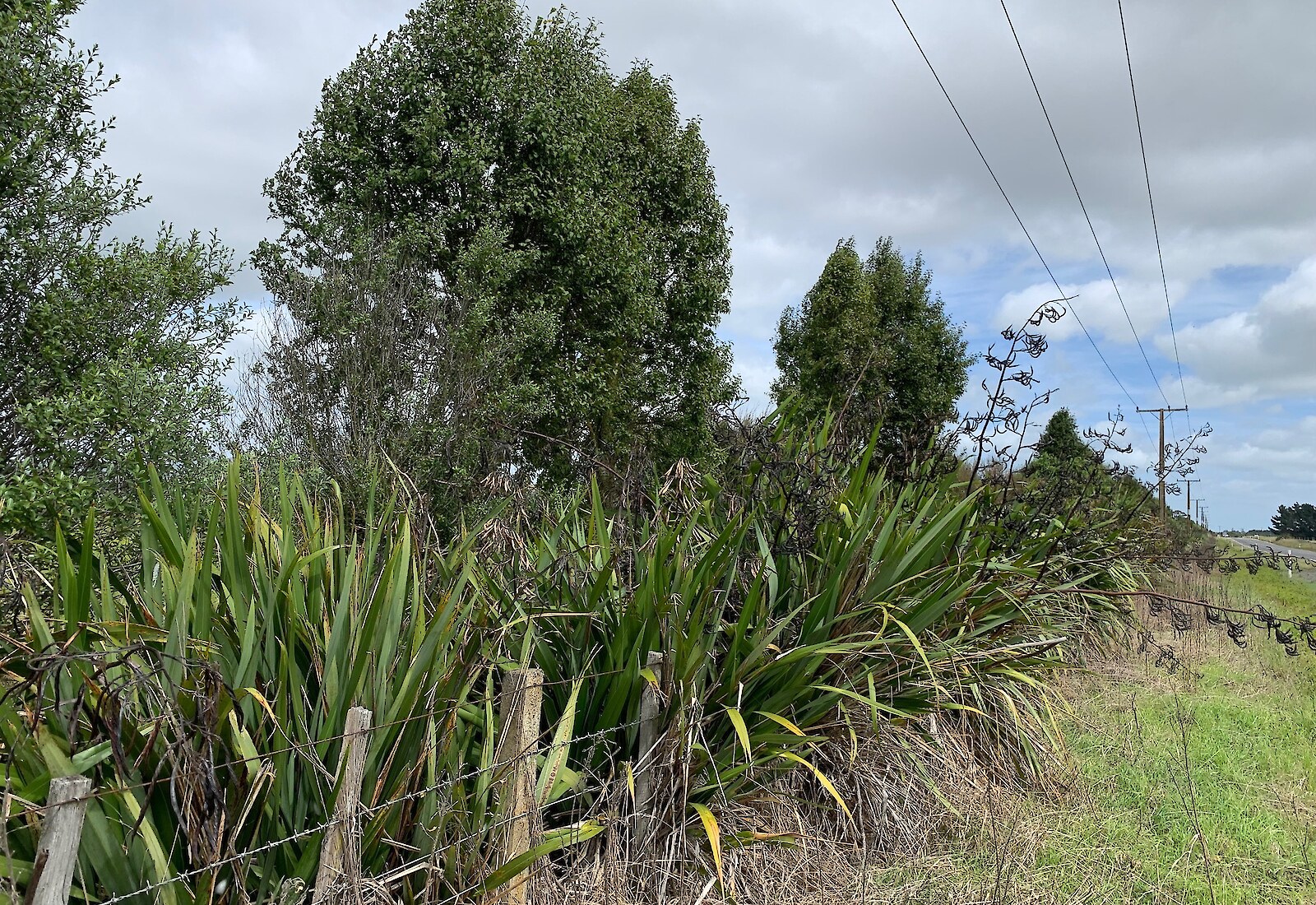
A multi-species shelterbelt of native shrubs and trees adding indigenous biodiversity to intensively farmed landscapes.

A multi-species shelterbelt of native shrubs and trees adding indigenous biodiversity to intensively farmed landscapes.

Exotic species like tree lupin, marram grass and pines have been used to stabilise coastal sand dunes more and act as a buffer to protect productive forestry and farmland inland from onshore winds and salt, particularly along exposed high energy coastlines such as the west coast of the North Island. Research is underway in transitioning these exotic-dominated coastal buffers, many of which are failing, to more effective permanent barriers of diverse native coastal forest. Coastal zones are amongst the most degraded ecosystems in New Zealand, so establishing and managing a sequence of native vegetation from native sand binders on foredunes to coastal shrublands on mid-dunes and a landward zone of native, coastal high forest will provide critical salt and wind shelter for landward production exotic forestry and farming. In addition, restoration of diverse native coastal communities will reduce erosion, help mitigate expected impacts of climate change including sea level rise and increased storms, and restore coastal forest biodiversity.

Providing trees for shade can reduce heat stress and production decline in grazing farm animals. Similarly in urban areas, shelter and shade have both direct and indirect benefits to city dwellers as part of green spaces to mitigate the built environment of cities and towns. There are a number of native tree and shrub species that can be planted as shelter, screens and specimen trees to provide shade, shelter, beautification, soil stability, green infrastructure for flood protection, and in the long term, the option of producing specialty timber both in urban and rural areas.

Landscape and aesthetic benefits

Planting native trees and shrubs offer many opportunities in both urban and rural environments to integrate indigenous biodiversity in the places we live and work.

Native forests are an important part of New Zealand’s spectacular natural landscape, and they are intrinsically part of New Zealand’s cultural identity. Worldwide, people across all cultures and regions generally express an aesthetic preference for natural environments over urban or built ones, However, the conversion and degradation of natural environments have often diminished these aesthetic values.

A survey of rural landowners in New Zealand indicated that the most popular reason for planting trees was aesthetic landscape values. These are particularly difficult to objectively quantify. There is limited research on aesthetic values in landscapes both here and overseas; however, studies consistently indicate that people prefer landscapes that include mountains, natural waterways and forest.

Evidence of preference for native forests rather than exotic plantations in landscapes is provided by district and regional plans, which identify outstanding natural features and landscapes. Exotic forests are usually excluded from outstanding or significant landscape designations. Also, clear-fell harvesting of plantation forests has large aesthetic impacts. In contrast, native forests are commonly mapped in many significant landscape designations.

Review of environmental values of native forests

Led by trustee Dr Jacqui Aimers, Tane’s Tree Trust has reviewed both national and international literature on non-timber values in native forests (which include environmental regulating values). The focus was on New Zealand’s native forests outside of the conservation estate. The information within this factsheet is based on this review, which includes over 300 references. For more information refer to TTT bulletin Non-timber Values in Native Forest.

Native forest factsheets series

These factsheets on establishing native forest have been compiled by Tāne’s Tree Trust with funding from Te Uru Rākau’s One Billion Tree Partnership Fund with support from The Tindall Foundation and Trees That Count. Others providing information and undertaking peer review include Scion, Auckland University of Technology, Northland Totara Working Group, iwi, landowners and selected local authorities and government departments.

Information and recommendations are provided by Tāne’s Tree Trust in good faith based on interpretation of information collated and reviewed which must be assessed by users on a case-by-case basis and/or specific technical advice for their sites. Accordingly, Tāne’s Tree Trust is not liable on any ground for any loss, claim, liability or expense arising from or due to any errors, omissions or advice provided within these factsheets.

© 2025 Tāne’s Tree Trust • Website by RS

  • Home
  • Ecosourcing of native species for planting
  • The basics of planting natives
  • TTT home
  • Natural regeneration of native forests
  • How to establish "seed islands" of natives
  • Site preparation for planting natives
  • Getting ready for planting
  • How to plant native seedlings
  • Planting nurse species – the concept of succession
  • Establishing a woodlot of native trees
  • Environmental values of native forests
  • Cultural and social benefits of native forests
  • Economic potential of native forests
  • Planting native forest – selecting the right species for the right site
  • Monitoring success of planted natives
  • Collecting and handling seed of native trees and shrubs
  • Resilient native forest in an era of climate change
  • Converting clear-felled exotic plantation forest to native
  • Selecting the right nursery-raised native seedlings for planting
  • About