Tāne’s Tree Trust Documents

  • About
  • TTT home

Establishing Native Forests

Download PDF
Tāne’s Tree Trust
Establishing Native Forests

Establishing Native Forests

Tāne’s Tree Trust Factsheet Series

Collecting and handling seed of native trees and shrubs

Factsheet 15

Refer to the other factsheets in this series for more about successfully establishing native forests.

The ripe red berries of miro are favoured food for kereru, the New Zealand pigeon. Miro and matai produce seeds enclosed in a fleshy plum-like covering. Germination of miro and matai is delayed for one or more years after seed collection.

The ripe red berries of miro are favoured food for kereru, the New Zealand pigeon. Miro and matai produce seeds enclosed in a fleshy plum-like covering. Germination of miro and matai is delayed for one or more years after seed collection.

Introduction

Availability of quality seed from the appropriate sources is vital to the success of forest restoration programmes. Most native forest restoration programmes rely on planting nursery-raised seedlings of a selection of shrub and tree species. Many projects involve planting thousands of seedlings where the vast majority of plants are raised from seed.

Collection of seed by individuals, skilled seed collectors and native plant nurseries requires a knowledge of the species - including seeding characteristics and timing of seed maturity - and skills in collecting, storage and treatment before sowing.

Seed collection, handling, storage and germination are described in this factsheet for the more commonly planted native shrubs and trees raised in nurseries for restoration planting programmes.

Seed availability and quality

Green seed of totara seed still attached to red receptacles recently fallen below a seeding tree.

Collecting seed of native shrubs and trees can be fraught with challenges. Each species has their own seeding characteristics requiring in-depth knowledge to allow planning and effective seed collection to provide viable seed that will produce good quality plants. Factors to consider with seed collection include:

  • Collecting seed of native species is labour intensive and time consuming. It inevitably requires collecting by hand, either by stripping seed from lower branches, sometimes climbing to access seed or cones, or collecting fallen seed from the ground.
  • For many natives and particularly some key tree species, there can be considerable variation in annual seed production and optimum seed collection times within and between regions. Seed processing and storage methods also vary between species.
  • Some native tree species are dioecious, i.e., they have separate male and female plants; identifying the gender of parent trees quickly will save time and effort in searching for seed.
  • For larger scale operations, seed needs to be available in sufficient quantities to meet requirements and at a reasonable cost. This often influences the quantity of seedlings raised annually and the cost per seedling.
  • The Department of Conservation has published a calendar for seed collection of the most commonly raised native trees and shrubs used in planting forest. Refer to links and tables below for seeding characteristic and collection and handling methods for commonly raised native shrub and tree species used in restoration programmes.

Planning

Kahikatea heavy with fruit. Like most podocarp species, kahikatea are dioecious, i.e., trees either produce pollen (i.e., are male) or seed (i.e., are female). The female cone is reduced to one ovule with a seed-bearing fruit. The name podocarp means ‘foot seed’, i.e., the seed is at the end of the fruit rather than enclosed by it.

A carefully designed seed collection programme will increase the likelihood of successfully collecting seed of most of the desired species each year. However, due to the natural annual variation in seeding quantity and timing of seeding for many native species, there is no guarantee that all species can be collected in sufficient quantities every year.

Many of the commonly planted native shrubs and monocots used as a nurse cover comprise species that are not only hardy but also seed prolifically, so large quantities of seed can be collected quickly. These include karamu, manuka, kohuhu, ti kouka/cabbage tree, akeake, tarata/lemonwood, harakeke, toetoe, koromiko and five-finger. A smaller number of key native tree species seed in regular or large quantities each year. Totara and kahikatea seed in moderate to large quantities most years, whereas rimu, tanekaha, mangeao and the beeches can be more erratic seeders. Species such as matai and miro also have delayed germination.

It is therefore essential to plan planting programmes to allow 1-3 years for nurseries to obtain seed from appropriate sources, and raise seedlings of the required species in the quantities and with the planting stock specifications that are needed.

Approval to collect seed

All plants and their seeds are protected by law when they grow on a reserve. Permission is required from the manager of the reserve such as the Department of Conservation or the local regional and district council to collect seed. To collect seed on private land, contact the owner to seek permission.

As native trees and shrubs seed over long periods of time from mid-summer to winter, varying depending on the species, site and local climate each year, several visits may be required across multiple sites to check on seed development. Seed collectors therefore must plan well ahead of time to seek approval for access from landowners and managers.

Seed collection practices

Best practice guidelines for collecting seed of natives includes:

  • Where practical, collect seed from natural shrubland and forest rather than planted areas, especially where the origin of established plantings is not known. This is becoming increasingly difficult as millions of natives are planted each year, so common sense is required. Presence of a large number of variegated or coloured cultivars of natives in a potential seed collection stand is usually a good sign that it was planted. Avoid collecting from these sites.
  • Collect seed from a wide selection of the population, rather than just from one spot. It is important to collect seed from a sufficient number of parent trees (at least 10 per provenance but preferably a much greater number) to maximise genetic variation.
  • Avoid collecting seed from cultivars such as variegated ti kouka, five-finger and red akeake and red manuka, that have been widely planted.
  • Avoid collecting from unhealthy or aberrant individuals.

The practice of collecting seed from plants that are acclimatised plantings of unknown origin, rather than wild populations, is a compromise of the ecosourcing concept.

Ecosourcing

Ecosourcing is defined as the sourcing of seed from nearby natural populations to propagate native planting stock for planting in the same locality.

There is ongoing debate amongst planters, foresters and ecologists on the role of ecosourcing and in particular defining the boundaries for local provenances. Some regard ecosourcing as particularly important for ecological restoration projects. Others contend it may be less relevant for other types of plantings such as for amenity values, arboretums, or for selection of plants for particular traits when establishing a resource for timber or other potential uses.

The concept and principles of ecosourcing, issues with implementation and recommendations are described in Factsheet 2 of this series.

Call for a new approach to ecosourcing

From Peter B. Heenan, William G. Lee, Matt S. McGlone, James K. McCarthy, Caroline M. Mitchell, Matthew J. Larcombe & Gary J. Houliston (2023) Ecosourcing for resilience in a changing environment, New Zealand Journal of Botany.

“Climate change, extinctions across multiple trophic levels, habitat loss and fragmentation, spread of invasive species, and novel habitats have completely altered the contemporary biotic landscape. Conservation needs to engage with these changes if it is to protect and restore ecosystems. Restrictive ecosourcing is counter-productive as it limits utilising genotypic, phenotypic and ecotypic diversity, and thus the evolutionary potential of indigenous species and ecosystems. It also reduces opportunities to protect biodiversity when populations are small, and limits response to climate change.”

They recommend setting up nine broad ecosourcing regions and that, within these regions, phenotypic adaptation to particular environments be used as a guide to seed selection. This approach to ecosourcing will improve restoration outcomes through increasing species and genetic diversity, reducing the detrimental effects of inbreeding and promoting the genetic rescue of populations of threatened species. They provide examples of adopting an eco-evolutionary approach to ecosourcing for the early-successional coloniser kanuka (Kunzea species) and late-successional conifer species.

Nine proposed eco-evolutionary regions for ecosourcing overlaid onto Regional Council regions (from Heenan et al. 2023).

They suggest that

“…ecosourcing regions provide a general guideline, or rule of thumb, and should not be considered a hard boundary restricting all transfers. The proposed scheme is not to be interpreted as doctrinaire and we encourage common sense and practical application near boundaries – after all our main goal is to encourage ecosourcing from across much larger areas than is currently practised and not to be overly restrictive.”

Quick tips for easy seed collection and handling

Seed collecting

Titoki, a small tree of coastal and lowland forests and commonly planted as a street tree in urban areas, has clusters of furry brown capsules that split as seed ripens. The distinctive fleshy red fruit partly surrounds a shiny black seed which can be picked by hand from lower branches.
  • Target edges of naturally established forest where there is often a wider variety of species from shrubs to trees and lower branches that allow easier collection of seed.
  • Avoid collecting seed from previously planted areas unless the origin of those planted natives is known; this also reduces inadvertent collection of cultivars and variegated natives that have been widely planted.
  • Use gloves to strip seed from heavily laden shrub hardwoods by running hand down the branch with an open bag held beneath.
  • For fine, wind-dispersed seed such as pohutukawa, insert part of the branch laden with newly opened capsules into a large open bag and shake the branch to dislodge the seed.
  • For large trees where seed is out of reach in the canopy, laying or suspending hessian sheets or similar light material beneath seeding trees during autumn for 2-4 weeks can be effective in collecting falling seed. Care is required to ensure that understorey vegetation is not damaged or shaded for too long. Sheets will require securing at corners and weighing down to prevent wind flapping.
  • For shrub hardwood species such as manuka and kanuka, where trimming of branches is acceptable, cut branches laden with capsules just as they are starting to open and place in a bag. Take back to the nursery and allow to dry further in a warm, sunny, sheltered area to encourage capsules to open. After a few days, shake branches within bags to dislodge seed.
  • Aim to collect seed within a locality from a minimum of 10 individuals, ideally spaced over several hundreds of metres to obtain seed from a diverse genetic mix. Mix seed collected of the same species from the same area.

Seed handling and processing

  • Where practical, use paper bags to store seed to avoid sweating and overheating during transport, especially if dry seed is collected.
  • While plastic bags are commonly used during seed collecting as they are likely more durable, care is required to ensure seed does not deteriorate during transport or temporary storage.
  • Label all collection bags at the collection site as described below.
  • In general, sow seed within months of collection when viability will be best. If seed cannot be sown right away, use appropriate seed storage methods for the species (refer to Tables 1 and 2 below for commonly planted native trees and shrubs).
  • Seed of some species (e.g., kauri) quickly lose viability unless appropriate seed storage methods are used.
  • Seed of a few less commonly planted species such as swamp maire will need to be sown immediately as the seed is recalcitrant, i.e., the seed quickly loses its viability, and standard seed storage methods do not work. If this is the case, plan in advance to sow the seed as soon as possible after it is collected.
  • For species with wind dispersed seed, ensure that seed does not blow away during collection or transfers between storage containers. Store wind dispersed seed in dry conditions, preferably in paper bags until sowing.
  • Avoid long storage as viability will reduce significantly over time, especially for species with small seed.
  • For species with bird dispersed seed either enclosed within fleshy drupes or attached to receptacles, place seed in a plastic bag in a fridge to maintain moist cool conditions. Allow flesh to rot during moist cool storage, then wash off fleshy material and dry the seed by spreading out on a tray for easier sowing.
  • More information on harvesting and storing native seed is available in a useful handbook by Metcalf (2007) – see this listed in the resources below.

Labelling and record keeping

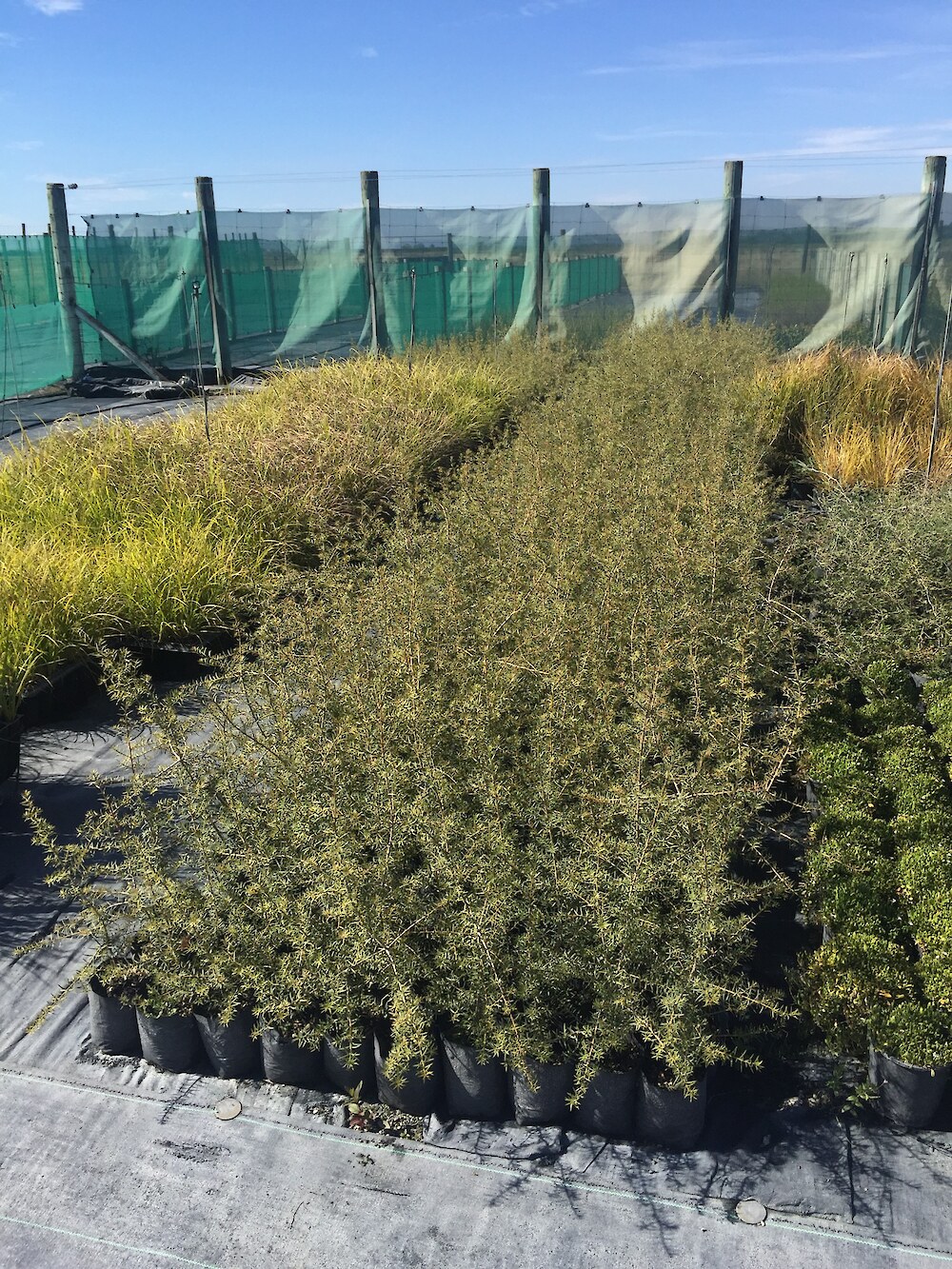
A range of native shrub species raised in a small-scale nursery. Labelling by species and seedlot identification is equally important in small and large-scale nursery operations to verify seed source location.

Carefully labelling and record keeping is needed throughout seed collection, storage, sowing and propagation. Seed packet labelling needs to be legible and durable for storage depending on storage conditions such as moist or dry cool conditions.

Before removing the seed from the field, place seed into a bag and label as follows:

  • Location of seed collection (preferably with GPS)
  • Date seed collected
  • Name of collector(s)
  • Approximate number of trees/shrubs seed collected from
  • Any other notes of interest, such as a habitat description (optional)

It is in the interest of seed collectors, seed merchants and nurseries to provide accurate detailed records of seed collection as proof that ecosourcing is being practised. Those purchasing native seedlings from nurseries should be requesting evidence of record keeping checking that appropriate species of known origin are being supplied. If nurseries cannot provide this information, planters may need to consider other supply options.

Poor germination and dormancy

Seeds of many New Zealand native species are inherently poor germinators. Although low viability may be responsible for this, there is increasing evidence that poor germination of some native species may be caused by seed dormancy, i.e., the failure of viable seed to germinate despite being exposed to favourable environmental conditions.

Dormancy may result from physical mechanisms such as seed still being contained in fleshy fruit or an impermeable seed coat and/or physiological mechanisms such as embryo dormancy and chemical inhibitors in the seed. There are various techniques for breaking seed dormancy in native species including stratification (chilling) for a period, exposure to light, scarification (cutting or chipping the seed coat), and chemical treatment (e.g., concentrated sulphuric acid, gibberellic acid, smoke).

Breaking seed dormancy is very species-specific, and several methods may be needed for rapid seed germination of different species in seed mixtures. In practice, for any species, breaking seed dormancy may not be worth addressing unless a large number of seed is affected and the seed is in short supply. Refer to Tables 1 and 2 for information on seeding characteristics, seed collection and handling, and storage and germination for the more commonly planted native forest species.

A review of seed germination requirements is available (Rowarth et al. 2007) – see this listed in the resources below.

Transplanting wildings

The removal of small seedlings from forest and scrub sites, often termed ‘wildings’, can be an option for some species where it is difficult to collect sufficient seed or where germination is poor or slow to occur. Permission is required from landowners for access to forest sites where there is an abundant supply of small seedlings germinated on the forest floor. Using a trowel, small seedlings 10 to15 cm high can be carefully dug up to recover as much of the root system as practical for transplanting direct to small containers in the nursery. Care is required to keep seedlings moist, cool and in the shade during transport.

Collecting and transplanting wildings is labour-intensive, and mortality of transplants can be high, so it is only practical on a small scale. It has been successfully used for species such as matai and miro that may take several years to germinated from freshly collected seed. Best survival and growth has been with wildings less than 15 cm tall.

Seed collection for commonly raised natives

Seeding characteristics and seed collection practices for the most commonly planted shrub, monocot, and tree species are shown in the sections below.

Shrub hardwood and monocot species are widely used in restoration programmes, and as a nurse crop for inter-planted native tree species.

Tree species are often planted at a lower density within a sheltering nurse cover of shrub hardwoods and can be planted as a potential long-term timber resource.

Native shrub and monocot species

White berries of ti kouka/cabbage tree ripen on large, branched spikes that grow within the crowns. It is easiest to cut one of the spikes off when the seed is ripe in autumn and strip the berries off by hand. Each berry contains several black seeds and can be stored in moist cool conditions until sowing.

Seeding characteristic and collection and handling methods for commonly raised native shrub hardwood and monocot species used in restoration programmes and as a nurse for tree species.

Manuka (Leptospemum scoparium)

Seeding characteristics: Flowers appear in early spring and capsules appear in autumn and persist on branches for months. Seeds annually. Should always be ecosourced carefully because it is so variable across the country.
Collection: Mature seed capsules can stay unopened on the branches for a long time so seed is available for collection for several months. Cut off branches with unopened capsules or strip capsules off plant by hand.
Handling, storage and germination: Place capsules in a paper bag or branches with capsules on a tray in a warm dry place until the fine red seed is released by shaking from capsules. Store seed dry and cool before sowing. Viability reduces with long storage time. Easily raised in large quantities as bare-root or in containers.

Ti kouka, cabbage tree (Cordyline australis)

Seeding characteristics: White berries each containing several black seeds ripen in autumn. Borne on large loosely branched clusters or spikes within the crowns. Seeds annually but seeding of individual trees can be erratic.
Collection: Remove part or all of the branched cluster of berries before they are shed. Strip berries from cluster by running hand along each branchlet.
Handling, storage and germination: Moist cool storage in fridge until sowing. Wash off softened pulp and dry seed to allow easier spreading of seed for sowing.

Karamu (Coprosma robusta), Shining karamu (Coprosma lucida)

Seeding characteristics: Orange/red fruit ripens between February and August. Produces seed from an early age in large quantities most years.
Collection: Strip clusters of seed by running hand down branches. Store in plastic bag in fridge.
Handling, storage and germination: Sow fresh or allow the fruit pulp to soften during moist cool storage and wash before sowing. Good germination and easy to propagate in containers or bare-root.

Harakeke, flax (Phormium tenax), Wharariki, mountain flax (P. cookianum)

Seeding characteristics: Dry wind-dispersed seed form within upturned capsules at top of tall flower stalks which mature in autumn. Seed is dispersed as capsules dry and split open.
Collection: Collect black dry capsules by cutting off stalks before capsules split releasing seed. Numerous seed is in each capsule, so select one stalk per plant.
Handling, storage and germination: Store seed dry and cool until sowing. Germinates readily. Easy to propagate in containers or as bare-root plants.

Toetoe (Austroderia species)

Seeding characteristics: Fluffy wind-dispersed seed borne within large flower clusters on tall stalks which mature in autumn. Several native species but can be confused with exotic pampas species.
Collection: Ensure correct species identification for planting in each region and to avoid collecting exotic pampas species which are noxious weeds. Before seed is dislodged by wind, cut off seed head and place in a paper bag.
Handling, storage and germination: Store seed dry and cool until sowing. Germinates readily. Easy to raise in containers or as bare-root plants.

Akeake (Dodonaea viscosa)
The small light brown winged capsules of akeake contain black seeds that are distributed by wind. Capsules are collected by hand off shrubs and stored dry before sowing.

Seeding characteristics: Small light brown winged capsules contain small black seeds that are distributed by wind. Seeds from January to April.
Collection: Remove capsules by hand from shrubs and place in paper bag.
Handling, storage and germination: Allow capsules to dry and split, aided by rubbing if necessary. Sieve to remove unwanted material. Store dry and cool before sowing. Easy to propagate.

Koromiko (Hebe stricta)

Seeding characteristics: Produces racemes (stalks) s of flowers turning to capsules and seeds that are wind dispersed.
Collection: Strip the capsules from racemes by hand before they open and turn brown.
Handling, storage and germination: Keep capsules in a paper bag in a warm dry place to open and release seeds. Store seed dry and cool until sowing. Easily propagated.

Five-finger (Pseudopanax arboreus)

Seeding characteristics: Flower buds can be easily mistaken for ripe fruit whereas clusters of fruit are actually ripe one year after flowering.
Collection: Collect clusters of matured fruit by hand from low branches.
Handling, storage and germination: Separate seed from clusters. Mash the ripe black fruit and wash to separate the pulp from the seeds.

Kohuhu (Pittosporum tenuifolium), Karo (P. crassifolium), Tarata (P. eugenioides)

Seeding characteristics: Capsules split to reveal sticky, shiny, black seed for bird dispersal. Seeds in autumn but seed can be retained within sticky capsules for months.
Collection: Some flexibility in collecting seed from autumn onwards. Hand pick capsules from branches that are split or about to be open.
Handling, storage and germination: Remove seed from capsules mixing with sand to reduce stickiness for ease of handling. Store dry and cool until sowing.

Broadleaf/kāpuka (Griselinia littoralis)

Seeding characteristics: Shiny dark purple/black berries are ripe in April/May. One seed is contained within each berry.
Collection: Pick off bunches of berries by hand in autumn and place in bag.
Handling, storage and germination: Scrub the thin fleshy coat from the seed by rubbing. Store cleaned seed in moist cool conditions until sowing soon after collection. Easily propagated from fresh seed. Can be raised in containers or as bare-root.

Tauhinu/cottonwood (Ozothamnus leptophyllus)

Seeding characteristics: Masses of white flowers produced in December-March. Fruiting March-April. Fluffy, fawn seeds are dispersed by wind.
Collection: Hand pick large quantities of fluffy seed directly from branch tips in autumn.
Handling, storage and germination: Seed germinates without pre- treatment. Four weeks of cold dry stratification will help speed up and even out germination time. Easily propagated in containers.

Native tree species

Seeding characteristics, seed collection and handling methods, and propagation for commonly raised native tree species.

Kauri (Agathis australis)
Kauri trees are monoecious, i.e., male and female flowers are found on the same tree. Kauri has cones that are spherical in shape, with numerous seed that are dispersed when the cones break up while on the crown. Skilled tree climbers are required to collect cones from larger trees before they break up.

Seeding characteristics: Cones mature in mid-summer, breaking up in the crown and scattering seed from early February onwards. Male and female flowers found on the same tree.
Collection: Collect cones in late summer when winged seed is first noticed on the ground and before remaining cones break up. Climbing skills are required to collect cones. Alternatively, lay sheets on the ground to collect seed falling from trees above.
Handling, storage and germination: Store seed dry in air-tight containers to maintain viability. Fresh seed usually germinates within a month of sowing. Germination rates from northern stands may be better than from trees located further south. Fibrous feeding roots can be slow to develop, so less suited to bare-root propagation. Care is required in container production to avoid woody tap roots becoming distorted.

Totara (Podocarpus totara)

Seeding characteristics: Separate male and female trees. Annual seed crop fluctuates in abundance but usually seeds every year. Seed remains green, attached to ripe yellow-red fleshy receptacles that attract birds. Some trees produce empty seed even when receptacles have formed. Fallen seed turns brown but may be viable.
Collection: Collect from autumn to early winter. Pick seed attached to ripe receptacles by hand from lower branches. Alternatively, collect fallen brown seed using dustpan and hearth brush from bare ground from beneath trees through winter.
Handling, storage and germination: Sift seed collected from ground to remove unwanted material. Store in moist cool conditions until sowing in spring following collection. Germination is often irregular and may occur in 2 phases (e.g., spring and autumn from same seedlot). Dense fibrous root system suited to bare-root or container propagation.

Rimu (Dacrydium cupressinum)

Seeding characteristics: Separate male and female trees. Infrequent and irregular seeding. Good seeding only occurs once or twice per decade. Empty and undeveloped seed is common.
Collection: Seed collection can be difficult due to erratic nature of seeding. Lay sheets below large trees to collect falling seed and check regularly.
Handling, storage and germination: Cool storage in plastic bag placed in fridge until sowing. Sow seed immediately or after cool-moist storage in a refrigerator. Reluctant to form dense fibrous roots so often best raised in containers.

Kahikatea (Dacrycarpus dacrydioides)

Seeding characteristics: Separate male and female trees. Seeds most years with heavy crops every 3-5 years. Pattern of seeding is local. High proportion of viable seed with heavy crops. Seed is ripe when receptacles are yellow to red.
Collection: Pick ripe seed by hand from lower branches or lay sheet under tree during autumn and check regularly for fallen seed.
Handling, storage and germination: Cool storage in plastic bag placed fridge until sowing. Wash off rotting pulp from dry seed to allow easier sowing. Seedlings readily for fibrous roots and grown easily from fresh seed in containers or as bare-root.

Seed of kohekohe are borne in capsules that grow directly out of the tree branches or trunks. Green capsules can turn light brown and split to release several fleshy seed which are highly palatable to rats.
Miro (Prumnopitys ferruginea)

Seeding characteristics: Separate male and female trees with small yellow catkins on males that are ripe in October/November and black fruit on females ripening in March/April.
Collection: Collect seed off the ground or from lower branches. As with miro, slow to germinate from fresh seed. Alternatively collect aged seed contained in litter beneath seeding trees.
Handling, storage and germination: Delayed germination of fresh seed due to thick woody seed coat, so requires long-term, cool, moist storage in a plastic bag in fridge. Test germination with a sample one or more years after collection. Alternatively sow forest duff with older seed from beneath seeding trees.

Tanekaha (Phyllocladus trichomanoides)

Seeding characteristics: Seeds are nutlike and borne within a cup shaped white fleshy receptacle, usually with one seed but sometimes a few seeds in each. Light annual seed crops with infrequent good seed years.
Collection: Often both sexes occur on the same tree. Seed can be picked by hand from low branches during April and May. High incidence of empty seed in some localities. Uneven seed ripening on small trees. Seed in litter collected from beneath seed trees has produced seedlings.
Handling, storage and germination: Some have found it easy to propagate from fresh seed. Transplants well and is hardy once established. However, can have poor germination in cool upland nurseries. Can be raised bare-root or containerised.

Puriri (Vitex lucens)

Seeding characteristics: Seeds over many months but peaks in autumn. Large-crowned trees produce many berries that are pink-red when ripe.
Collection: The large fruit each contain one rough-textured “stone”. Fruit turn black when they fall on the ground where they can be collected.
Handling, storage and germination: Keep stone-like seed dry and cool until sowing. Seed sown in late summer generally germinates the following spring.

Rewarewa (Knightia excelsa)

Seeding characteristics: Annual seeds crops variable. The seed capsules mature in early winter, splitting open to release winged seeds dispersed by wind.
Collection: Can be difficult to collect seed out of reach from the ground. Use extendable snips to cut velvet red clusters before they split and release seed.
Handling, storage and germination: Store unopened capsules in warm, dry conditions to assist splitting and release of seed. Store seed dry and cool until sowing. Moderate germination rates. Easy to propagate from fresh seed. Roots systems tend to be coarse and woody so seedlings better propagated in containers rather than as bare-root.

Kohekohe (Didymocheton spectabilis)

Seeding characteristics: Seeding irregular and local. The green capsules within small clusters grow directly out of trunks or large branches and open to reveal orange fleshy fruit. Seed highly palatable to rats.
Collection: Seed ripen is late autumn/early winter. Collect capsules as they begin to split and before predation. Capsules have 3-4-cells with 2 seed per cell. Seed must be removed from the capsule. ​​​​​​​
Handling, storage and germination: Good germination of carefully cleaned seed. High viability but cannot withstand drying out.

Seed capsules of pohutukawa will turn brown during autumn and split releasing hundreds of tiny seeds. Holding a paper bag over recently split clusters of capsules and shaking the branch will dislodge large quantities of seed quickly.
Titoki (Alectryon excelsus subsp. excelsus)

Seeding characteristics: Clusters of furry brown capsules, each containing a single seed. Capsules split when ripe to reveal a fleshy red fruit partly surrounding a black seed.
Collection: Seeding over several months from summer to winter. Hand pick seed from split capsules from lower branches.
Handling, storage and germination: Fruit rots during moist cool storage. Wash to provide clean seed for sowing. Easy to raise from fresh seed.

Mangeao (Litsea calicaris)

Seeding characteristics: Large oval dark purple drupes occurring from summer to autumn. Food for kereru and tui.
Collection: Difficult to collect large quantities of seed. Collect off the ground or from lower branches.
Handling, storage and germination: Although easily grown from seed, mangeao is often fickle and hard to maintain in the nursery. Rarely available from nurseries.

Kanuka (Kunzea species)

Seeding characteristics: Seeds annually. Seed is ready for collection around March. Should always be ecosourced carefully because a variety of species occur across the country. Small woody capsules quickly release seed on opening.
Collection: There is only a small ‘window of opportunity’ to collect the dry capsules as seed is quickly dispersed by wind. Cut sprigs with capsules or strip by running hand along branchlets.
Handling, storage and germination: Place capsules within paper bags in warm dry conditions to release seed. Store seed temporarily, dry and cool, as viability drops quickly. Easily raised in large quantities as bare-root or in containers.

Pohutukawa (Metrosideros excelsa)

Seeding characteristics: Prolific seeding each year and easily raised in nurseries. Flowers appear around Christmas and mature seeds in February and March for wind dispersal.
Collection: Collect seed by holding bag beneath recently opened capsules and shake to dislodge fine seed​​​​​​​.
Handling, storage and germination: Store dry and cool until sowing. Viability drops with extended storage.

Silver beech (Lophozonia menziesii), Red beech (Fuscospora fusca), Mountain beech (Fuscospora cliffortioides), Silver beech (Lophozonia menziesii)

Seeding characteristics: Small, winged nuts fall in autumn and dispersed by wind. Heavy seed crops during occasional mast years but light crops most years. Check trees early for a proliferation of small red flowers which likely signals a good seeding year. Separate male and female flowers borne on same tree.​​​​​​​
Collection: Typically produce seed from February to April with only a 2–4-week window to collect when the seed is mature and ready to fall. Shake lower branches containing seed that will readily dislodge onto sheets of hessian or similar laid beneath. Sieve to remove twigs as required. Seeds are just big enough to handle and can be picked up from ground but better to harvest just before release stage. Readily eaten by rats and mice. ​​​​​​​
Handling, storage and germination: Typically produce seed from February to April with only a 2–4-week window to collect when the seed is mature and ready to fall. Shake lower branches containing seed that will readily dislodge onto sheets of hessian or similar laid beneath. Sieve to remove twigs as required. Seeds are just big enough to handle and can be picked up from ground but better to harvest just before release stage. Readily eaten by rats and mice.

Raising plants from seed vs cuttings

Propagation via seed should always be the preferred option for restoration of permanent native forest. Planting cuttings of the same genotype within the same forest stand effectively lowers genetic diversity and may result in poor performance in future generations of the planted population due to inbreeding depression.

It is particularly important in an era of climate change to maximise genetic diversity, as this increases genetic resilience. For poor seeders, rooted cuttings can be used to bulk up stock, but rooted cuttings must be used judiciously. If use of cuttings is absolutely necessary, these should be collected from a minimum of 10 parent plants and from a wide area of plants in a natural population rather than just from plants in one spot. Care must be taken to avoid planting trees raised as cuttings from the same parent (i.e., ramets from the same clone) within the same stand.

Resources

Totara is most often raised from seed as it easily collected from female trees either by hand from lower branches or as fallen seed below seeding crowns by hand or sheets laid beneath during seedfall. Like a number of native trees and shrubs, totara can be raised from cuttings, but this requires specialised nursery skills and equipment such as misting and bottom heat.

There are a large number of online resources and reference books available providing information on seed characteristics of native trees and shrubs along with seed collection, handling and storage methods, and propagation techniques.

  • Descriptions of native trees and shrubs with photographs and information on seed and seeding characteristics are available on the New Zealand Plant Conservation Network website.
  • For seeding information on for a wider range of commonly planted native shrub and tree species refer to these guidelines produced by the Department of Conservation (DOC).
  • For further information on seed collection and propagation of native trees often planted for timber production, refer to Bergin and Gea (2007) NZ Indigenous Tree Bulletin No. 3.
  • Use this table compiled by DOC to check for the optimal time of year for seed collection, as well as what to look for when collecting seeds of native trees and shrubs.
  • More information on propagation of native plants is available in a handbook by Lawrie Metcalf. Metcalf, L. 2007: The propagation of New Zealand native plants. Second edition. Penguin Random House, New Zealand.
  • See Rowarth et al. (2007) for a review of germination requirements. Rowarth, J. S., Hampton, J. G., & Hill, M. J. 2007: New Zealand native seed germination requirements: A review. New Zealand Journal of Botany, 45(3), 485-501. doi:10.1080/00288250709509732
  • The Wakatipu Beech Seeding Project provides information on seed collection, processing and storage for selected shrub and trees species used in seeding and planting programmes in central Otago.

Native forest factsheets series

These factsheets on establishing native forest have been compiled by Tāne’s Tree Trust with funding from Te Uru Rākau’s One Billion Tree Partnership Fund with support from The Tindall Foundation and Trees That Count. Others providing information and undertaking peer review include Scion, Auckland University of Technology, Northland Totara Working Group, iwi, landowners and selected local authorities and government departments.

Information and recommendations are provided by Tāne’s Tree Trust in good faith based on interpretation of information collated and reviewed which must be assessed by users on a case-by-case basis and/or specific technical advice for their sites. Accordingly, Tāne’s Tree Trust is not liable on any ground for any loss, claim, liability or expense arising from or due to any errors, omissions or advice provided within these factsheets.

Tāne’s Tree Trust

© 2026 Tāne’s Tree Trust • Website by RS

  • Home
  • Ecosourcing of native species for planting
  • The basics of planting natives
  • TTT home
  • Natural regeneration of native forests
  • How to establish "seed islands" of natives
  • Site preparation for planting natives
  • Getting ready for planting
  • How to plant native seedlings
  • Planting nurse species – the concept of succession
  • Establishing a woodlot of native trees
  • Environmental values of native forests
  • Cultural and social benefits of native forests
  • Economic potential of native forests
  • Planting native forest – selecting the right species for the right site
  • Monitoring success of planted natives
  • Collecting and handling seed of native trees and shrubs
  • Resilient native forest in an era of climate change
  • Converting clear-felled exotic plantation forest to native
  • Selecting the right nursery-raised native seedlings for planting
  • About